

Why Affiliate Content Isn’t Converting (And How to Fix It)
January 28, 2026Affiliate marketing has a ghost program problem. A structural, industry-wide issue where networks and tracking platforms present a catalog of opportunity that does not reflect a living marketplace.
David Paxton of AvidAffiliate conducted a Skimlinks analysis, which our industry rarely does, and it deserves credit for that alone. It is not a hot take. It is not a vendor deck. It is a straightforward look at the numbers behind a network directory, and the numbers tell an uncomfortable story.
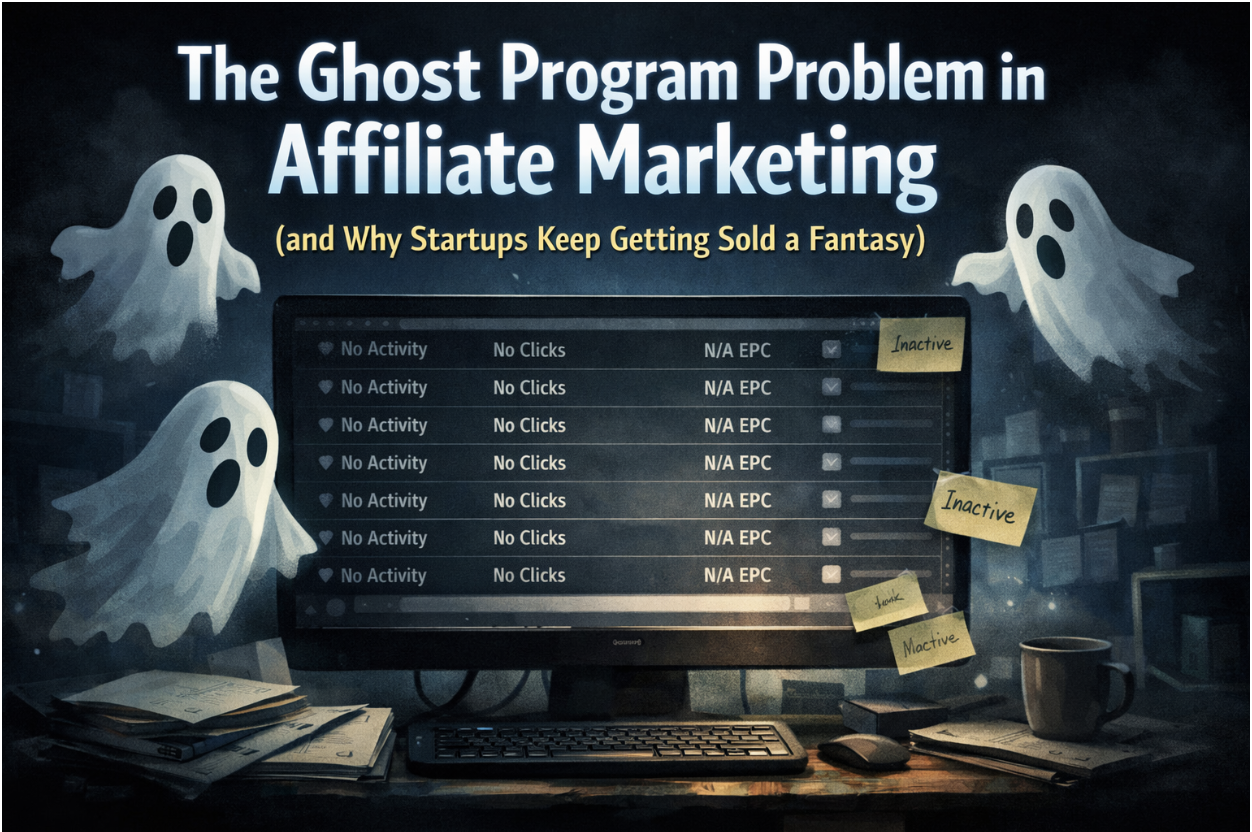
The report lists 28,844 programs in Skimlinks, which includes all the major networks and tracking platforms. Two-thirds of them, 66.5 percent, show no click data. No earnings per click (EPC), no commission rate, no basket size, no conversion rate. That does not prove a program is permanently dead, but it does mean there is no evidence of meaningful activity on that network.
This is what I mean by ghost programs. They exist on paper. They exist in network counts. They do not exist in a way that builds partner confidence, drives consistent publisher engagement, or delivers measurable performance. A mall with mostly dark storefronts can still claim it has 200 tenants. That does not help publishers who are shopping for offers worth testing.
There are too many affiliate programs that are built on hope and optimism, and it's hurting everyone.
Too many programs were launched because someone needed to close a deal, show progress, or check a channel box. Network sales reps have quotas. Agencies want to give it a real effort. Founders want a cheap, fast, and easy money machine. All of those motives are understandable. None of them changes the physics of affiliate marketing.
Affiliates are not employees. They are not your early customers. They are independent operators who place bets. They look for proof that the bet is worth taking.
Most startups do not have that proof.
Affiliate marketing is not the solution to your startup growth problem if you do not already have sales velocity and a site that converts.
What EPC Is Really Telling Us
Paxton's report uses EPC as the headline metric, and it works well for this dataset. EPC is “earnings per click,” basically what a partner expects to earn, on average, each time they send you a visitor. He is measuring whether the directory represents real earning potential at scale. The distribution is brutal. Among programs with measurable EPCs, the median is $0.14. Two-thirds earn less than $0.25 per click. Only 531 of the 28,844 programs break the $1.00 EPC. That is the real size of the opportunity pool.
Many people will read that and conclude, “EPC is everything.” That is where I disagree, and I want to be precise about why.
I do not treat EPC as a north star inside a well-balanced program. A blended EPC gets skewed by traffic type and promotion method. A full-funnel partner mix includes content creators who influence decisions early, review partners who educate and compare, email and communities that reintroduce the offer, and coupon, loyalty, and cashback partners that close late. Some of those partners send hundreds of clicks with no sales. That lowers the blended number, even when those clicks contribute to awareness or assisted conversions. A low overall EPC does not mean the right affiliates cannot win. It usually means the program has a broad mix of partner types, uneven traffic quality, or an offer that converts well only in specific contexts.
But in this report, EPC works as a smoke alarm. When most listings do not even register performance data, and the measurable layer concentrates in a small fraction of programs, the message is not “optimize your EPC.” The message is “the marketplace is thinner than the catalog, and most offers are not earning enough to attract serious testing.”
The Real Lever Is Conversion
Paxton makes the point that the commission rate alone is misleading because it ignores basket size and conversion rate, and he uses EPC to capture the full economic equation. That is correct, but the most important lever in that equation is still conversion. An aggressive commission cannot improve a low or nonexistent conversion rate. A high payout from a weak funnel is just a more expensive way to learn the same lesson.
The report breaks high-EPC programs into two paths. The first is a large basket with a modest commission. Finance and Insurance averages a $1,277 basket at 12.2 percent commission. Travel and Accommodation averages $612 at 6.4 percent. You do not need a generous commission rate when someone books a $1,700 hotel stay at 5 percent. The second path offers a high commission and a high conversion rate. Pets averages a $112 basket, with an 8.1 percent commission and a 6.1 percent conversion rate. Food and Drink averages $92 at 9.5 percent with a 5.5 percent conversion rate. Volume compensates.
The trap is the middle. Software and Technology shows the highest average commission rate of any vertical at 31.6 percent, yet it posts the lowest EPC at $0.22, which the report attributes to a 2.1 percent conversion rate. That is the industry in one sentence. Everyone wants to lead with commission because it feels like generosity. Affiliates want proof that shoppers actually buy.
If you are a founder, the honest question is which path your product sits on. If your basket is small and your conversion rate is average, the math does not work for most affiliates, regardless of what you pay them.
When a brand asks me why affiliates are not showing up, the answer is almost never recruiting. The answer is readiness. Serious affiliates do not want to be your QA team. They do not want to burn their audience with an offer that does not convert. They do not want to send traffic into a checkout experience that leaks, breaks, confuses, or underperforms. They do not want to be the first real test of your pricing, your shipping promise, or your site speed.
And conversion is only part of the equation. The study also tracks reversal rates by vertical, which measure how often a credited sale gets cancelled, returned, or reversed before the affiliate gets paid. Partners are not just evaluating whether traffic converts. They are evaluating whether the sale sticks. High reversal rates signal operational problems on the brand side, and they erode the trust that makes affiliates willing to test your program in the first place.
Stop Treating Affiliate as a Launch Checkbox
Affiliate marketing is not a shortcut to starting a startup. It is an amplifier. It amplifies a product that already sells. It amplifies a funnel that already converts. It amplifies an operator who can recruit, educate, activate, enforce terms, and manage incentives over time.
If you are a founder or a brand-side marketer reading this, the action is not “go chase affiliates harder.” The action is to start treating affiliate like a credibility test. Affiliates are the market's bluntest form of feedback. They do not care what you intended. They care what converts.
If you want your program to be alive, you need evidence that your offer works before you ask partners to bet on it. You need consistent sales. You need a conversion rate you can defend. You need an offer structure that does not require heroics. You need clear terms, a clean site experience, and a reason for a partner to choose you over the hundreds of other programs that look identical on a directory page.
Paxton's research is valuable because it removes a layer of polite fiction. It shows that the industry has a long tail of listings and a short list of real earners. That is not an attack on affiliate marketing. It is a reminder of what affiliate marketing actually is: a performance marketplace with zero patience for wishful thinking.
Affiliate marketing is not dead. The ghost programs are.