

Beginner’s Guide to Setting Up Affiliate Partnerships in 2026
January 12, 2026
Why Affiliate Content Isn’t Converting (And How to Fix It)
January 28, 2026I've spent my career educating brands on what affiliate marketing actually is, not what people wish it was. That work led me to build two public GPTs designed to force the right questions early, before you spend 90 days learning them the hard way.
The same patterns keep showing up. Brands either launch with unrealistic expectations or inherit an existing program and have no clear way to diagnose what is actually broken. In both cases, the result is the same: frustration, stalled growth, and a conclusion: “Affiliate doesn't work.”
Affiliate does work. But only when you treat it like a channel with structure, accountability, and daily decisions.
So I built two public GPTs to force the right questions early, before you waste money and time, and then declare the channel broken.
The problem these GPTs solve
Most affiliate problems are not mysterious. They are structural.
Programs stall because tracking is shaky, terms are vague, commissions don't align with the market, partners are approved with no strategy, and nobody owns day-to-day decisions. Brands also underestimate what it takes to recruit and support partners who have real options. Then month four, the easy wins dry up, and the program gets labeled a failure.
On the flip side, brands considering affiliate marketing often get sold the fantasy version. “Just join a network.” “Affiliates will find you.” “Set it and forget it.” That advice is expensive. It burns time, reputation, and budget.
These GPTs are designed to cut through that.
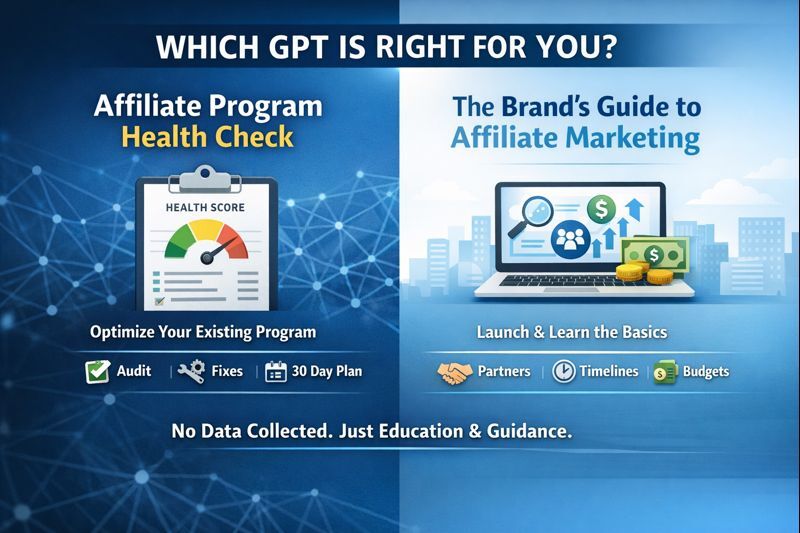
GPT #1: Affiliate Program Health Check (for brands already live)
This is for brands with an existing program that feels stalled, messy, or overly dependent on a single partner type.
It walks you through a short intake and returns three things: a scorecard, the highest-impact fixes, and a 30-day action plan. It covers the stuff that actually breaks programs in the real world: tracking integrity, terms and enforcement, partner mix, creative and assets, operational ownership, and how decisions get made day to day.
You stop guessing. You get a practical path that focuses on fixing the biggest constraints first, not rearranging small details that don't matter.
GPT #2: The Brand's Guide to Affiliate Marketing (for brands considering a launch)
This is for brands thinking about launching, evaluating whether affiliate fits their business, or trying to understand what they are buying before choosing a platform or hiring someone to “manage affiliates.”
It explains how affiliate programs actually work from the brand side, without the hype. Partner types, timelines, budget expectations, what “good” looks like in the first 30 to 90 days, and the common structural mistakes that cause programs to die around month four. It gives short answers first, then deeper detail if you want it.
The goal is to prevent the most common launch mistake: starting a program you cannot support, then blaming the channel when it stalls.
One key point on privacy
I do not see your answers. I am not reading your inputs or collecting your program data. These tools are for educational and self-assessment purposes. Think of them as a structured checklist and a reality filter, not a consulting intake form.
Why I made them public
These GPTs are not meant to replace an experienced affiliate manager. They are meant to raise the floor for decision-making. If you are a founder, CMO, or marketing lead, you should be able to tell the difference between a healthy program and one that is quietly rotting behind a dashboard.
If they help you avoid a bad launch, fix a broken foundation, or ask better questions in your next meeting, they did their job.
How to access them
Both are public in ChatGPT. Search the names in Explore GPTs:
Free to use. No pitch attached. I'll keep improving them throughout the year based on what people get stuck on most.