

The Broken Window Effect in Affiliate Marketing
July 28, 2026Apogee has managed affiliate programs since 2009. Ask us how to run one well, and the answer starts before recruitment and runs about 18 months.
Impact published six affiliate program management tips on Friday. The direction is right. Programs built on coupon and cashback partners hit a ceiling, and the fix is treating partnerships as relationships instead of transactions. We agree, and we default new client programs to Impact for that reason.
The tips describe the destination well. What they leave out is the daily work of getting there. The reason is not length. Every source in the post comes from Impact: its case study, its 2025 State of Affiliate Marketing report, and its own podcast. A platform can tell you that management matters. It has a harder time telling you what the manager does on a Tuesday.
Why Impact is publishing this now
The timing is not random. In April, Impact and Rakuten announced an alliance. Rakuten's affiliate programs move onto Impact's technology for tracking, reporting, and payments, while Rakuten shifts toward managed services. As that migration finishes, Impact takes on roughly 2,000 more advertiser programs.
Expect Impact to try to dominate the conversation around affiliate program management. A platform that handles the mechanics for a larger share of the market has every reason to define how brands think about running one. Content like this is how that starts. We read it as an opening move, and brands should read it the same way. Useful, and not neutral.
The number the tips will not give you
Impact says diversify beyond coupon and cashback. True. Its report puts the current average at three to four partner types across the customer journey. But diversify is a direction, not a target. A manager needs a number.
Here is ours, and it appears in “Think Like an Affiliate Manager.” Bottom-funnel partners, the coupon, cashback, and loyalty sites, should not exceed 40 percent of transactions. Twenty-five percent is better. New programs run higher, sometimes 100 percent, because upper-funnel content has not scaled yet. Expect that early. The job is to watch the trend line. If the bottom funnel still dominates after 12 months, the program needs work, not patience.
The goal is not to have your top 10 affiliates deliver 80 percent of sales. The goal is for the top 10 to deliver 40 percent while dozens of other partners carry the rest. A program balanced that way can absorb a loss and keep growing. A concentrated one breaks when a single algorithm change hits.
The timeline nobody puts in the case study
Impact's Elite Supplements story is real, and the results are strong. The risk is that a brand reads it and expects the same in a quarter.
It does not work that way. A mature program takes 12 to 18 months of steady management. By then it carries more than 100 relevant partners who understand the audience, content runs consistently, creator campaigns happen monthly, and leadership treats the channel as an engine rather than a test. Before that, you are building. Recruiting weekly, seeding product, answering partners within hours, and correcting the mix. None of that shows up in a case study, and all of it determines whether there is a case study to write.
Set the expectation early. A brand that budgets for 18 months makes decisions a brand chasing a 90-day result cannot. There is no trial period. Brands need to commit to the long term because they will never be satisfied with a ‘trial.'
The step between recruiting and revenue
The tips cover recruitment and compensation. They skip the part where most recruited partners never post.
Activation is that part. A partner joins, hears nothing, and assumes the program runs on silence. So they treat it that way. The fix is not technology. It is a sequence: a welcome email, a follow-up on the second day, and a prompt around day 10. Those three touches double activation rates in most programs. They cost nothing but preparation. They tell a partner a real person is paying attention, which is the whole premise of a relationship-driven program.
A program that recruits well and activates poorly looks busy and earns little. The roster grows. The revenue does not.
The word missing from the whole post
Read all six tips, and you will not find enforcement.
The omission matters, because an unmanaged program does not stay neutral. It degrades. Absence of oversight reads as permission. Trademark bidders move in. Coupon and loyalty partners bend the terms because no one is checking. Browser extensions skim credit from the partners who actually drove the sale. In January 2023, Apogee inherited a program that showed this exactly. Traffic existed. Revenue existed. Judgment did not. Paid search violators, incentive traffic, and coupon arbitrage had taken over the roster while the content partners who build durable demand stayed away.
Enforcement is not policing for its own sake. It protects the partners you want by making the program a place they trust. Relationships and rules are the same work.
Who actually does this
Six tips, and none of them ask who runs the program.
A platform is least suited to answer that question, because the honest answer is often a person, not a product. Automation handles tracking, reporting, and contracting. It buys back time. It does not recruit a creator, negotiate a hybrid rate, read a compliance report and act on it, or defend the channel in a budget meeting. Those are judgment calls, and judgment is what a manager sells.
This is where independence matters. Apogee is family-owned, with no private equity behind it and no network ownership steering our advice toward the volume that pays the platform. Senior people do the work. There is no junior account layer. When we recommend cutting a coupon partner that inflates the numbers, we do it because the program is healthier without it, not because a quota says otherwise.
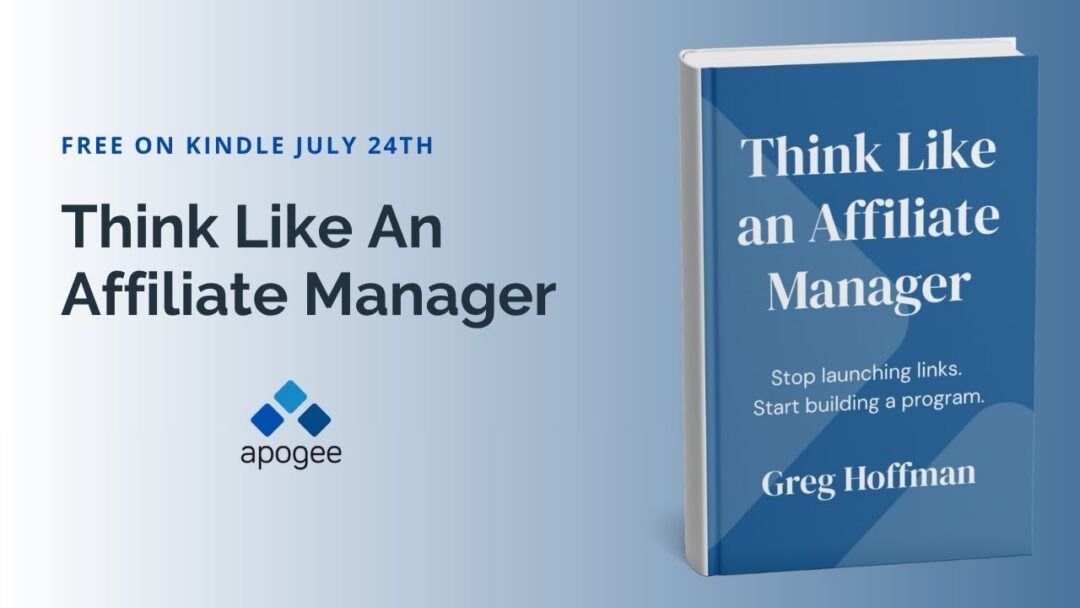
I wrote “Think Like an Affiliate Manager” to put that daily work on paper. The book is the long version of everything above.
Impact got the direction right, and the tips are worth reading. Just remember who wrote them and what they can and cannot cover. The relationship model they describe is real. Someone has to run it.
If you want to talk about what that looks like for your program, start a conversation with us at apogeeagency.com.
Frequently asked questions
How much of an affiliate program should come from coupon and cashback partners?
Bottom-funnel partners, meaning coupon, cashback, and loyalty sites, should not exceed 40 percent of transactions, and 25 percent is a healthier target. New programs often run higher because upper-funnel content has not scaled yet. Track the trend. If the bottom funnel still dominates after 12 months, the mix needs work.
How long does it take to build a healthy affiliate program?
Plan for 12 to 18 months of steady management. A mature program carries more than 100 relevant partners, runs content consistently, and produces predictable revenue. Results before that are early signals, not the finished program.
Why do recruited affiliates never start promoting?
Most fail to activate because the program gives them nothing to respond to. A three-part onboarding sequence, a welcome email, a second-day follow-up, and a day-10 prompt, doubles activation rates in most programs. Silence after signup tells a partner the program is not serious.
Do I need an affiliate manager if my platform automates the work?
Automation handles tracking, reporting, and contracting. It does not recruit partners, negotiate compensation, enforce terms, or advocate for the channel internally. Those are judgment calls. A platform runs the mechanics. A manager runs the program.
Should an agency or a platform define affiliate best practices?
Use both, but read the source. Platform guides are useful and often well-researched, though their advice tends to point toward the tools and the volume that benefit the platform. An independent manager has no such incentive. Weigh any guidance against who profits from it.