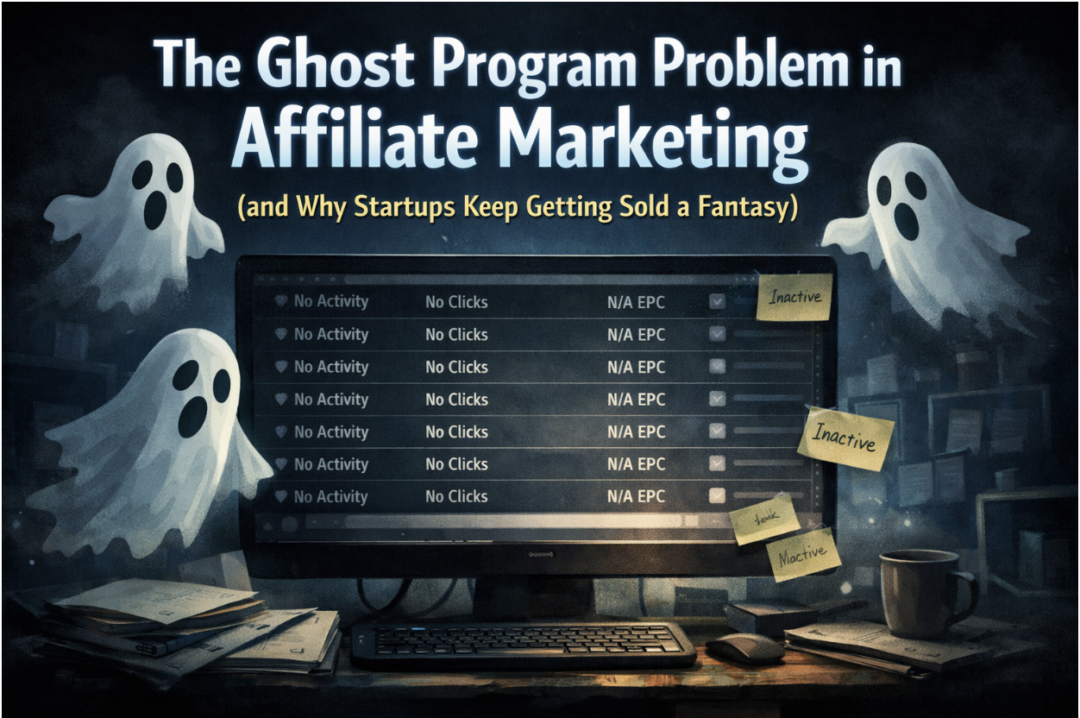


The Ghost Program Problem in Affiliate Marketing (and Why Startups Keep Getting Sold a Fantasy)
February 12, 2026People romanticize starting an affiliate business. Launch a program, approve some partners, and watch the sales roll in. The pitch travels well on social media, and a cottage industry of “experts” packages it as accessible, low-risk, and repeatable. Most of those businesses never get traction.
The version that works consistently is adding affiliate to a business that already sells something. When the product converts and the sales process holds up, affiliate becomes one of the most efficient channels you can run. You pay for results, not exposure. You extend your reach without incurring fixed media costs. You get access to audiences that are difficult to reach through paid channels alone. That only works if the underlying business already performs.
The Commission Trap
Affiliates run on conversion, not commission. Brands often miss this at launch. They set a rate, list the program, and wait. When applications do not come in, they increase the commission and expect that to fix it. It rarely does.
Experienced affiliates evaluate programs quickly. They read the description for substance, scan the terms, click through the tracking link, and review the landing page as a customer would. If the offer is unclear, if the checkout path is weak, or if the product does not hold up in its category, they move on. They do not leave feedback. They do not negotiate. They just do not apply.
Silence is not a lack of interest. It is a decision.
What Affiliates Are Actually Evaluating
An affiliate cannot make a weak product convert. They cannot repair a broken funnel. They cannot create demand where none exists. They are not there to build the business. They are there to extend something that already works.
This is why most standalone affiliate businesses struggle. They are trying to build content, grow an audience, find programs, and depend on someone else's conversion at the same time. Every variable is outside their control, and they do not get paid until all of them line up.
Affiliates invest time, content, and often their own ad spend. They expect a return. Before they commit, they look for signals that a program performs. What does the conversion rate look like? What is the average order value? What does earnings per click look like in practice? If those answers are unavailable or the numbers are not competitive, most serious partners will not test the program.
Commission only matters after conversion is proven. A higher percentage on a weak offer does not improve the outcome. A lower percentage on a strong offer can outperform it. Affiliates evaluate expected return, not headline rates.
Why Existing Businesses Have the Advantage
For a business that already converts, affiliate is low risk by design. There is no need to pre-fund media or guess at demand. The program sits on top of an existing sales engine and extends it. The brand brings product, pricing, and proof. The affiliate brings distribution.
That exchange also depends on credibility. Affiliates are putting their audience in front of your product. They are relying on your reviews, your brand recognition, and your track record to support that decision. A business with real customer validation gives affiliates something to work with. A new affiliate site has to build all of that from zero.
The Model That Holds
Affiliate marketing has held up across multiple shifts in how people find and buy products because the structure is simple. Partners influence decisions. Brands pay for outcomes. That model works when both sides bring something real.
It does not work as a shortcut to passive income. It does not work as a business-in-a-box. It is harder now for new affiliates building from scratch than it has been in years, especially as discovery shifts and competition for attention increase.
For a company with a product that converts, a sales process that functions, and data worth sharing, affiliate is one of the more durable and cost-efficient ways to grow revenue. It does not create demand. It expands access to it.