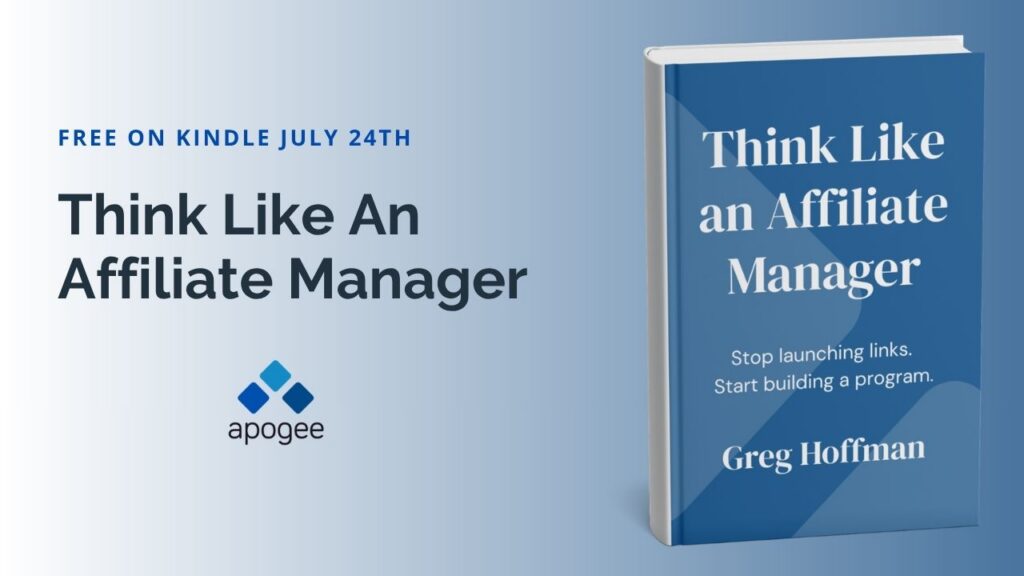


Think Like an Affiliate Manager: A New Book from Greg Hoffman and Apogee Agency
April 7, 2026
Ten Priorities to Evaluate When Choosing Affiliate Program Strategy Consulting
April 27, 2026After seven years of managing affiliate programs across a wide range of brands, there is one pattern that keeps showing up, and it has nothing to do with budget, platforms, or even the product itself. Brand owners get so deep into building and running their business that they slowly lose touch with what it actually feels like to be on the other side of the purchase.
That gap between how brands think people shop and how people actually shop has only gotten wider over the last few years. What worked even two or three years ago does not work the same way today, and a lot of brands are still operating like it does. That disconnect is where most affiliate programs start to struggle before they even have a real chance to work.
The Expectation Gap Is Bigger Than Ever
One of the biggest issues we see, especially with smaller or newer brands, is a set of expectations that simply do not align with reality. They want immediate sales, even though no one knows who they are yet; they expect conversions without any real social proof, and they hesitate to invest in creators while still expecting content and promotion to happen anyway.
On top of that, many are trying to sell higher-priced products without taking the time to build any real trust first. They are asking consumers to spend money before giving them a real reason to feel confident doing it, which is a hard sell in a market where people have endless options.
Affiliates Are Consumers First
One of the most common misunderstandings we see is how brands think about affiliates. There is still this belief that affiliates will promote an unknown brand for free simply because there is a commission attached, but that ignores the reality of how creators and publishers actually operate today.
Affiliates are consumers too. If they have never heard of your brand, have no experience with your product, and do not see proof that it converts, there is no real incentive for them to put their name behind it without being paid. From their perspective, they are being asked to take on all the risk while the brand captures all the upside, and that is not a compelling offer in a crowded market.
How Consumers Actually Shop Today
If you step out of the business owner mindset for a minute and think about how you personally shop, the shift becomes obvious. You are not seeing a product once and immediately buying it; you are seeing it multiple times across different platforms before it even starts to feel familiar.
You notice it in passing, then you see it again somewhere else, and only after that repetition does it start to stick. You look for real people using it, not just polished brand content, and you pay attention to comments, reviews, and how others are reacting before making a decision.
Most of the time, you are not in a rush to buy. There are too many options and too much noise for that. You might save it, think about it, come back to it later, and wait until it feels like the right time to spend. Especially if it is a higher-priced item.
That buying journey has gotten longer, not shorter, which means brands need more touchpoints to stay relevant throughout the process.
Why Repetition Matters More Than Ever
Because consumers are taking longer to make decisions, seeing a product once is rarely enough to drive action. Familiarity is built over time, and that requires consistent exposure across multiple creators and platforms.
This is where many brands get it wrong. They test one or two creators, do not see immediate sales, and assume the channel is not working. In reality, they have not created enough repetition for the product to even register with their audience yet.
Brands that are seeing success are working with multiple creators within a specific niche, so the same audience is exposed to the product again and again. That repetition builds awareness, and awareness is what eventually leads to trust and conversion.
The Amazon Reality Every Brand Is Competing With
There is another layer to this that many brands avoid, but it plays a major role in how consumers make decisions. When discovering a new product, a large percentage of people check Amazon before purchasing anywhere else.
This is not about loyalty; it is about convenience and trust. Shipping is fast, payment information is already saved, and the process is easy. Adding something to an existing order feels effortless compared to going through a full checkout process on a new site.
If a brand expects consumers to purchase directly from its website rather than on Amazon, there has to be a clear reason to do so. That might be better pricing, a meaningful discount, exclusive bundles, or added value that makes the extra steps feel worth it. Without that, convenience will win almost every time.
Affiliate Is Not Pay-for-Performance Anymore
A lot of brands still approach affiliate like it is a simple pay-for-performance channel where they can add links and immediately see revenue. That model does not reflect how the channel actually works today.
Affiliate now sits at the intersection of content, trust, and repetition. Creators need to be paid to create content, especially when there is no existing brand awareness or proof that the product converts. Expecting otherwise slows down growth before it even begins.
At the same time, brands often overlook micro and nano influencers, even though they consistently drive stronger engagement and more trust with their audiences. These creators may have smaller followings, but their influence is often more meaningful when it comes to actual purchasing decisions.
What Brands Need to Shift Right Now
The brands that are seeing real traction are the ones willing to adjust how they think about both consumers and affiliate as a whole. They understand that awareness comes before conversion, and they invest in creators early instead of waiting for proof that cannot exist without that investment.
They accept that it takes multiple touchpoints to earn trust, and they build strategies that create repetition rather than relying on one-off campaigns. They also give consumers a real reason to choose their website over Amazon, rather than assuming they will do it automatically.
Most importantly, they stop expecting immediate returns from audiences who are just discovering them for the first time. They understand that building a brand takes time, and they are willing to meet consumers where they actually are instead of where they wish they were.
The Bottom Line
Affiliate still works, but it works very differently than it did even a few years ago. The brands that continue to struggle are often the ones holding onto outdated expectations, while the brands that grow are the ones willing to adapt.
At the end of the day, the shift is simple but not always easy. The brands that win are the ones that stop thinking only as business owners and start thinking like the people they are trying to reach, because that perspective is what drives every real purchase decision.