

Why Affiliate Marketing Works Better as a Sales Layer Than a Business Model
March 26, 2026
Why Brands Forget What It Feels Like to Be a Consumer
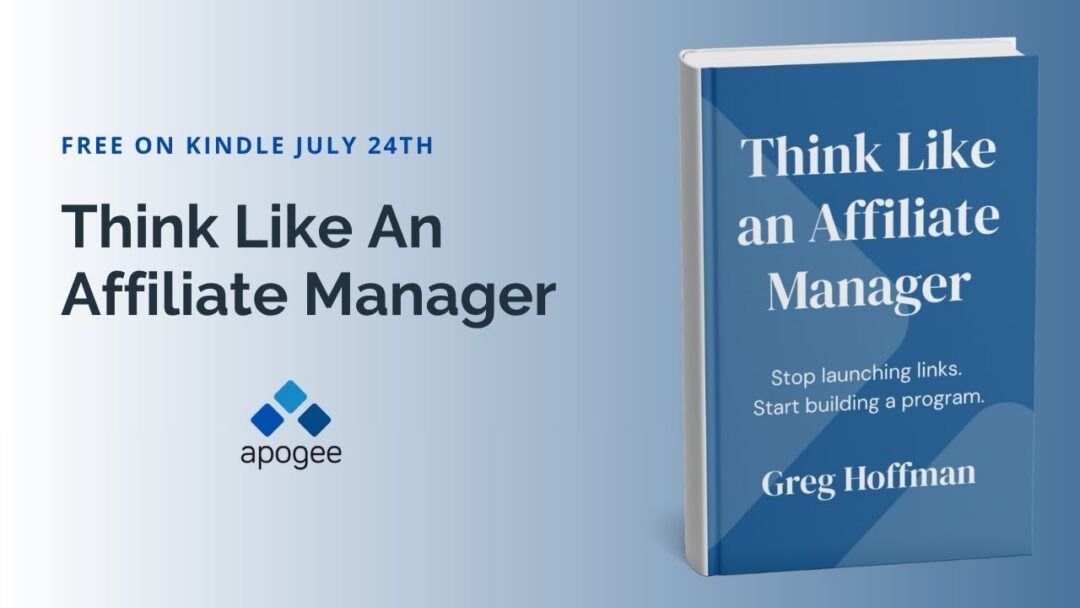
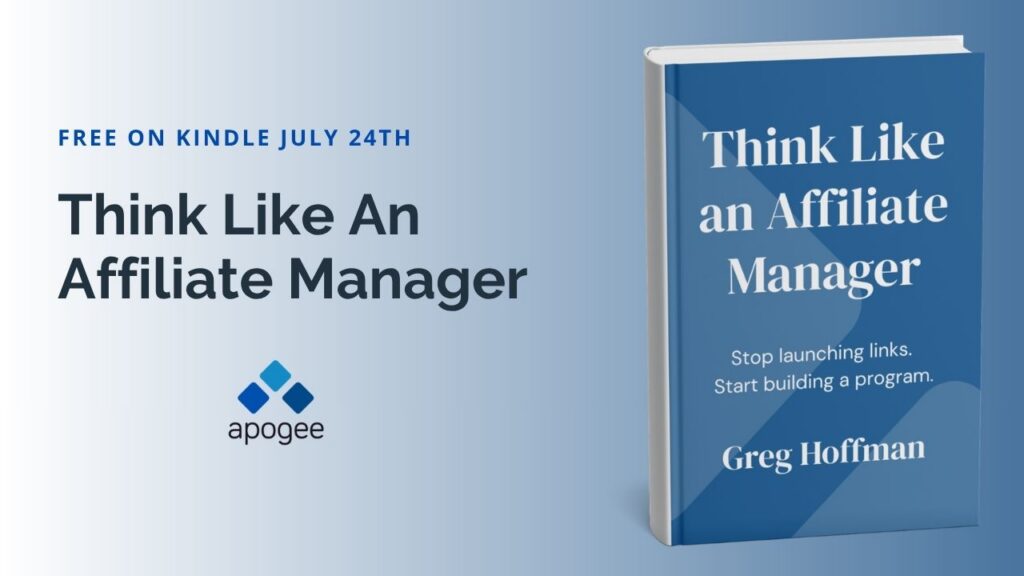
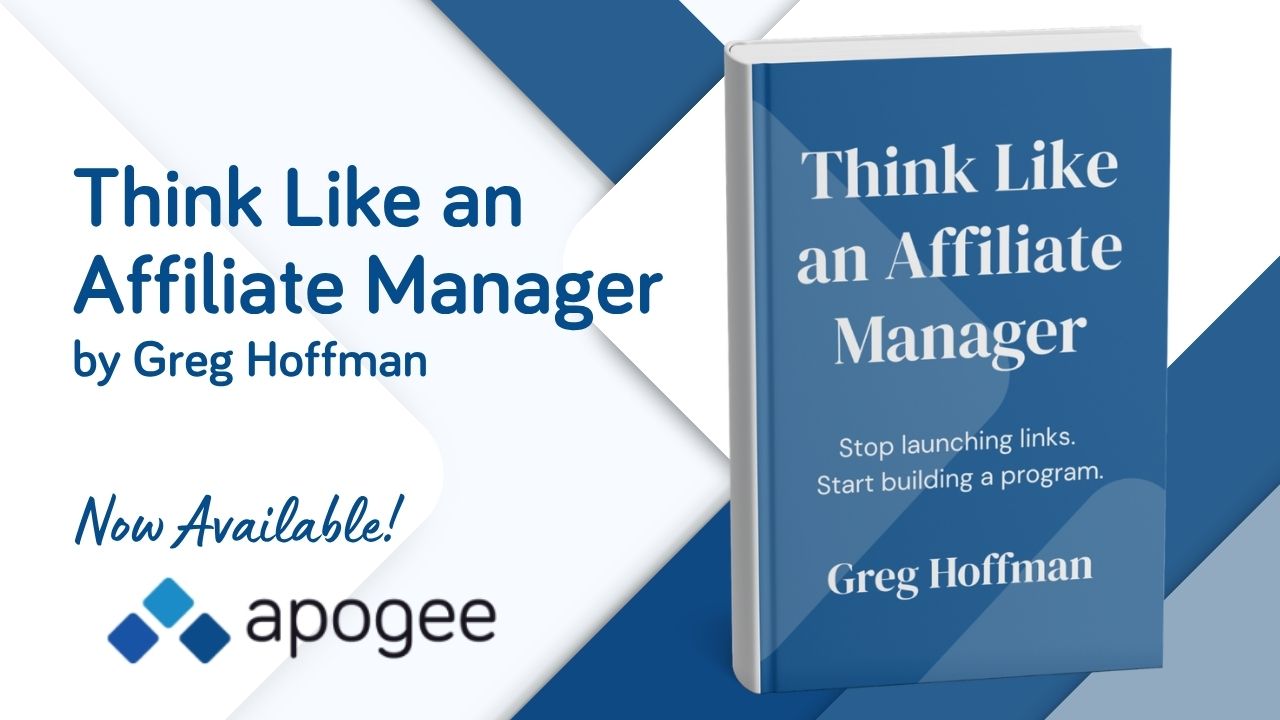
April 16, 2026After more than 20 years managing affiliate programs and helping brands generate more than $100 million in partner-driven revenue, Apogee Agency founder Greg Hoffman put everything he knows into one book.
Think Like an Affiliate Manager is not a beginner's guide to affiliate marketing. It is a working manual for the people who build, manage, and fix affiliate programs: in-house marketing teams, outsourced program managers, brand stakeholders, and anyone who wants to understand how real programs grow.
The book is available now at apogeeagency.com/affiliate-manager-book and on Amazon. Retail price is $29.99.
This post may contain affiliate links, which means if you click through and purchase, we may receive a commission at no cost to you. As an Amazon Associate, we earn from qualifying purchases.
What Is This Book About?
The affiliate marketing channel looks simple from the outside. A partner places a trackable link. A customer clicks and buys. The affiliate earns a commission. The brand gains revenue. What that picture leaves out is everything that determines whether the channel actually works.
Judgment, relationships, compliance, recruitment, partner education, activation, tracking technology, and long-term program structure are what separate programs that grow from programs that stall. Think Like an Affiliate Manager covers it all.
The book is written from the program management perspective. It is not a guide for affiliates or creators trying to grow their own income. It is written for the people on the other side of that relationship: the managers, agencies, brands, and marketing teams responsible for building something worth joining.
Foreword by Peter Shankman. Affiliate Voices contributors include 16 veterans who helped build the affiliate marketing industry over the past 30 years.
Chapter Synopses
Chapter 1: The Affiliate Manager
Affiliate management is judgment work. Every decision inside a program carries consequences: approving or declining an application, voiding a sale, setting a commission rate, or enforcing a term. Chapter 1 defines what an affiliate manager actually does, explains the three main branches of affiliate marketing (cost-per-sale, lead generation, and pay-per-call, and walled ecosystems), and makes the case for why pattern recognition built through real experience cannot be automated or shortcut. The chapter also traces Hoffman's entry into the channel through ABestWeb and the early community that shaped his standards.
Chapter 2: How the Industry Took Shape
Affiliate marketing did not emerge from a single invention. It grew through experiments, failures, community debates, and the people who stayed long enough to figure it out. Chapter 2 covers the industry's origins, from the BuyWeb program at CDNow in 1994 to the rise of Amazon Associates, the early tracking platforms, the ShareASale community, and the outsourced program management (OPM) model. This chapter draws on four early books that documented the channel's first 15 years and includes Affiliate Voices contributions from Brad Waller and Rachel Honoway.
Chapter 3: The Preparation Most Brands Skip
Most affiliate programs fail not because partners refuse to promote, but because the brand was not ready when it launched. Chapter 3 explains what real readiness looks like: a trusted tracking setup, a product that converts, an internal point of contact with real authority, and enough patience to let the channel build. The chapter establishes a realistic benchmark for early program performance, explains why partners approach new programs cautiously, and describes the most common missteps brands make in the first year.
Chapter 4: Optimization: Does Your Program Have the Juice?
Juice became shorthand for program readiness after a live panel format Hoffman created called “Does Your Program Have the Juice?” Experienced affiliates evaluated real programs on stage, with no prep time, while the brand watched from the audience. The evaluations were fast and consistent. Programs with structure earned consideration. Programs without it earned silence. Chapter 4 breaks down exactly how affiliates evaluate a program the moment they see it: the description, the terms of service, the datafeed, the creative assets, and the brand's own website. It also covers commission strategy, program cleanup, and what it takes to move from an existing program to one that affiliates trust.
Chapter 5: Recruitment: Who Belongs in a Modern Program?
Recruitment has never been about volume. Sending hundreds of invitations and approving every application adds clutter. Chapter 5 covers deliberate recruitment: starting with corporate partners (coupons, cashback, loyalty) to establish early stability, then moving to content partners who require research, personalized outreach, and follow-up. The chapter explains how to identify qualified candidates, how to pitch economics rather than a brand story, and how brand-to-brand partnerships can open new audience channels. It includes the story of a breed-specific pet-site recruitment campaign that produced partners who remained active for years.
Chapter 6: Education: Helping Partners Improve Their Craft
The best affiliate managers teach. Chapter 6 covers the full range of partner education: private affiliate communities, manager-built websites that answer common questions, platform certification programs, and the mindset shift that separates partners who understand the channel from those who guess their way through it. The chapter also introduces Lynsey Kmetz, Apogee's president, whose presentation from Greg Hoffman, “Think Like an Affiliate,” became the seed for this book.
Chapter 7: Activation: Guiding the Chaos
Partners join programs with the intention of promoting. Most never do. Chapter 7 is about the reality of activation: why it does not follow a timeline, why good partners go quiet for months and come back ready to work, and why brands consistently misread silence as failure. The chapter explains the roles of paid placements, product seeding, and seasonal timing, and what managers can do to reduce the friction between a partner's intention and their first piece of content.
Chapter 8: The New Partnership Triangle: Creators, Commerce Media, and Affiliates
Around 2018, badges from Forbes and CNET started appearing at Affiliate Summit. That shift turned out to be the early signal of something larger. Chapter 8 traces the convergence of traditional affiliates, editorial publishers, and creator-driven content into a single performance model. It covers the economics that pushed major publishers toward affiliate revenue, how Skimlinks built the infrastructure connecting editorial teams to brand programs, and why PR practitioners who launched affiliate programs out of necessity often did so wrong. The chapter includes the Katie Couric Media example as a case study in how mainstream properties began treating affiliate as a structured revenue channel.
Chapter 9: Coupons, Loyalty, Cashback, and Corporate Partners
Hoffman spent years declining coupon and loyalty partners on principle. Then he hired Cindy Ballard, whose daughter, Tricia Meyer, had built Sunshine Rewards from a mom blog into a loyalty platform. Chapter 9 is the result of that education. It explains the full range of bottom-funnel partners, how shopper psychology drives coupon behavior, the difference between corporate coupon sites and long-tail scraper sites, how browser extensions introduce attribution risk, and what it actually takes to manage these partners without letting them consume the program. The chapter also covers paid placements, attribution protection, and stand-down rules.
Chapter 10: Technology, Platforms, and Tracking
The technology layer of affiliate marketing is invisible when it works and costly when it fails. Chapter 10 covers the difference between networks and platforms, how tracking works, why last-click attribution creates bias, and how mixed-media modeling changes the way mature programs measure partner influence. The chapter includes a detailed look at the five platforms Apogee relies on for client work, an honest post-mortem on the ShareASale-to-AWIN migration, and a clear explanation of tracking loss and why planning for it matters more than fighting it.
Chapter 11: My Story
Greg Hoffman did not plan to become an affiliate manager. He came up through radio, newspapers, and public relations before the internet gave him something that combined writing, persuasion, and measurable results. Chapter 11 traces the full arc: the early in-house years, the 2009 launch of Greg Hoffman Consulting (now Apogee Agency) in Pensacola, the growth from first clients to a team, the conference relationships that built the business, and the moments where difficult decisions defined the agency's standards. Acknowledgments appear at the end of this chapter.
Chapter 12: The Future of Affiliate Marketing
Affiliate marketing has survived the dot-com crash, search algorithm updates, mobile commerce, platform consolidation, and years of predictions about its death. Chapter 12 explains why the channel endures, what will not change regardless of technology, and what the rise of generative AI means for affiliates, managers, and brands. The chapter addresses last-click attribution's slow decline, tracking loss, the professionalization divide between serious programs and weak ones, and the next generation of affiliate managers' needs to succeed. It closes with the same principle that opened Chapter 1: stop launching links, start building a program.
Affiliate Voices: The Contributors
The Affiliate Voices sections appear throughout the book, between chapters, and include interviews with 16 veterans who helped shape the affiliate marketing industry. These are not testimonials. They are first-person accounts from practitioners who lived through the channel's most formative years.
- Shawn Collins, co-founder of Affiliate Summit, co-author of Successful Affiliate Marketing for Merchants (2001)
- Brad Waller, co-founder of EPage Classifieds, builder of one of the first affiliate distribution models
- Rachel Honoway, affiliate marketing pioneer, former OPM, industry advocate
- Carolyn Tang Kmet, former Client Services Director at ShareASale, CMO and affiliate leadership roles at Groupon and Orbitz
- Wade Tonkin, senior affiliate and partnerships leader at Fanatics
- Mike Buechele, affiliate program strategist, co-panelist on the original “Does Your Program Have the Juice?” sessions
- Brook Schaaf, CEO of FMTC and soon to be published author
- Joe Sousa, Senior Manager, North America Affiliate and Partnerships at Fanatics
- Liz Gazer, affiliate marketing educator and content strategist
- Trisha Lyn Fawver, affiliate marketing conference veteran and industry connector
- Stephanie Robbins, affiliate and influencer marketing strategist
- Geno Prussakov, founder of AM Navigator, author of Affiliate Program Management, An Hour A Day (2011)
- Mike Nunez, affiliate program management leader and entrepreneur
- Daniel M. Clark, 2018 ShareASale ThinkTank Award winner
- Eric Nagel, affiliate technology developer and industry resource builder
- Tricia Meyer, Executive Director of the Performance Marketing Association (PMA), founder of Sunshine Rewards
Organizations and Platforms Referenced in the Book
The book's index focuses on industry professionals and organizations. The following platforms, networks, companies, and communities appear throughout the text:
- ABestWeb, the affiliate marketing forum that trained the first generation of affiliate managers
- Affiliate Summit, the industry's leading conference, co-founded by Shawn Collins and Missy Ward
- Amazon Associates, the program that popularized affiliate marketing at scale
- Apogee Agency, the outsourced program management firm founded by Greg Hoffman in 2009
- Avantlink, affiliate network
- AWIN / Affiliate Window, global affiliate network, acquirer of ShareASale
- Be Free, early affiliate tracking platform
- CDNow, host of the BuyWeb program, widely cited as an early functional affiliate model
- CJ (Commission Junction), affiliate network
- Dynamic Trade, early affiliate tracking platform
- eBay Partner Network, in-house affiliate program
- EPage Classifieds, co-founded by Brad Waller in 1994
- Everflow, performance marketing platform
- Fanatics, global licensed sports merchandise company
- FMTC (For Me To Coupon), affiliate data and coupon management platform
- Google Affiliate Network, closed 2013
- Groupon, used as a case study in commerce and affiliate integration
- Helping Moms Connect, early content and affiliate site built by Tricia Meyer
- Impact, partnership platform, primary platform used by Apogee Agency
- Instagram Shopping, platform-native commerce
- Katie Couric Media, featured as an example of mainstream editorial adopting affiliate commerce
- KowaBunga / MYAP, early affiliate program management software
- Levanta, affiliate platform for Amazon sellers
- LinkShare, early affiliate tracking platform
- MarTech Record, newsletter covering affiliate and performance marketing
- Orbitz, travel brand referenced in Carolyn Tang Kmet's Affiliate Voices section
- PartnerStack, SaaS-focused partner platform
- Partnerize, affiliate and partnership platform
- PepperJam, affiliate marketing agency and network
- Performance Marketing Association (PMA), trade association for the performance marketing industry
- Rakuten Advertising, affiliate network
- Refersion, affiliate and influencer tracking platform
- ShareASale, affiliate network in operation from 2000 to 2025, central to Apogee's history
- Skimlinks, subnetwork that automated affiliate link monetization for editorial publishers
- Sunshine Rewards, loyalty affiliate site founded by Tricia Meyer
- TikTok Shop, platform-native affiliate commerce
The Affiliate Manager Resource Center
Every copy of Think Like an Affiliate Manager includes a QR code linking to the Affiliate Manager Resource Center on the Apogee website. This page is a curated collection of the tools, communities, newsletters, and educational resources referenced throughout the book. It includes links to the industry newsletters Hoffman reads regularly, the affiliate marketing communities where managers build relationships and stay current, the GPT tools his team built to help brands assess program readiness, and the book recommendations that shaped his approach over two decades. The Resource Center is designed to extend the book beyond its pages. As the industry changes, the page updates. Readers who buy the book get a permanent on-ramp to the resources that experienced managers actually use.
Who Should Read This Book?
The book is written for:
- Affiliate program managers, both in-house and at agencies
- Brand marketing teams evaluating or already running an affiliate program
- Business owners who want to understand what real affiliate program management involves
- Marketing directors assessing whether to hire in-house affiliate management or outsource to an OPM
- Anyone who has ever been told that affiliate marketing is passive income or easy to automate
About Apogee Agency
Apogee Agency is a full-service affiliate program management firm based in Pensacola, Florida. Founded in 2009, the agency specializes in outsourced program management (OPM) for brands running cost-per-sale affiliate programs on platforms including Impact, CJ, AWIN, ShareASale, and others. Apogee has facilitated more than $100 million in client revenue across more than 17 years of active program management.
Greg Hoffman authored a previous ebook, Climbing the Affiliate Management Wall, in 2015. Think Like an Affiliate Manager is his first printed work and his most comprehensive statement on how affiliate programs are built, managed, and sustained over time.
Get the Book
Think Like an Affiliate Manager is available now.
Order directly: apogeeagency.com/affiliate-manager-book
Also available on Amazon. Retail price: $29.99.
If you manage an affiliate program, work with brands on performance marketing strategy, or are trying to understand whether your program is built to last, this book was written for you.