


Reddit Is Not a Social Media Channel. It’s Infrastructure.
June 10, 2026
Apogee Intelligence Lab: Ann Smarty on SEO, Reddit, and the Future of AI Visibility
July 7, 2026I became an affiliate manager in 2005. The first month-end report I built took two weeks to finish. Someone handed me a stack of hundreds of pages of printed green bar paper, and I had to read each number off the page and type the relevant fields into an Excel sheet by hand. I had to check formulas twice, hoping nothing was mistyped.
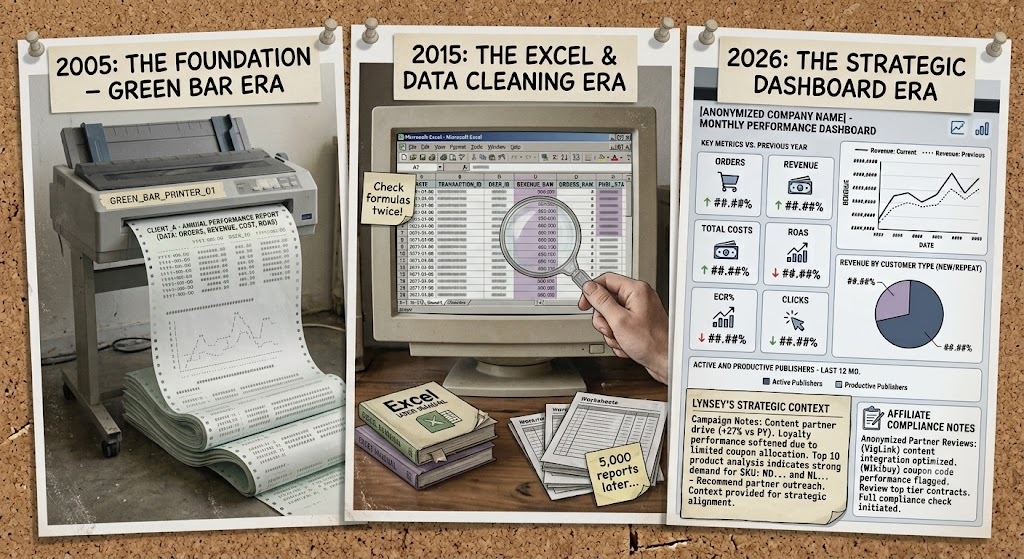
Twenty years and roughly 5,000 reports later, that same report takes about 20 minutes. The standard I held myself to back then never changed. The tools finally caught up to it.
Affluent, before it was Impact
We started using Affluent for affiliate program reporting years before Impact acquired the company in April 2021. At the time, Affluent operated independently out of Nashville, built specifically for agencies managing multiple clients across multiple affiliate networks. We adopted it early for one reason: it let us pull accurate numbers fast and turn them into something a client could read without help.
The acquisition changed the ownership. It didn't change how or why we use it. Affluent still does the job we hired it to do in the first place, which is pull the raw data cleanly so we can spend our time on the part that actually requires a person.
What goes into monthly affiliate reports
Every month, on the first, we pull the Affluent report for each brand we manage. That report becomes the backbone: orders, revenue, cost, ROAS, effective commission rate (ECR), active publishers, clicks, and conversion rate. Those numbers form the first paragraph of every report we send, and they never change format because consistency is part of the trust.
Then comes the part that takes real judgment. We review the affiliate network dashboard for anything that the top-line number doesn't explain. We research trends against the prior year. Lynsey adds campaign notes so the report reflects what actually happened that month with specific partners and promotions, not just what the export shows. That combination, hard numbers plus context, is what separates a report from a data dump.
The same standard now extends past the affiliate network. Creator and UGC campaigns, whether run through the network or outside, add an additional reporting layer there: reach, views, and engagement by creator get the same full write-up instead of a raw export. That's a different report with a different set of numbers, and it deserves its own post once the current campaign closes out.
Why we don't just send the dashboard
We don't screenshot a network dashboard and email it to a client with a note to reach out with questions. A client should never have to interpret their own performance data. Our job is to do that interpretation for them, in writing, every month, without fail.
That standard has held for close to two decades, across outsourced affiliate management engagements with completely different audiences, price points, and affiliate mixes. The format flexes to the brand. The commitment to a full breakdown does not.
Where this goes
The tools will keep improving, and reporting time will probably keep shrinking. What won't change is the reason we report on the first of the month, every month, without exception: a client who understands their own program makes better decisions, and a report that requires translation has already failed at its one job.
Five thousand reports in, that's still the whole point. If you manage affiliate programs yourself and want the full process behind this kind of reporting, pick up the book.